
FIBC Bags: Packaging Solutions for Dry and Bulk Goods
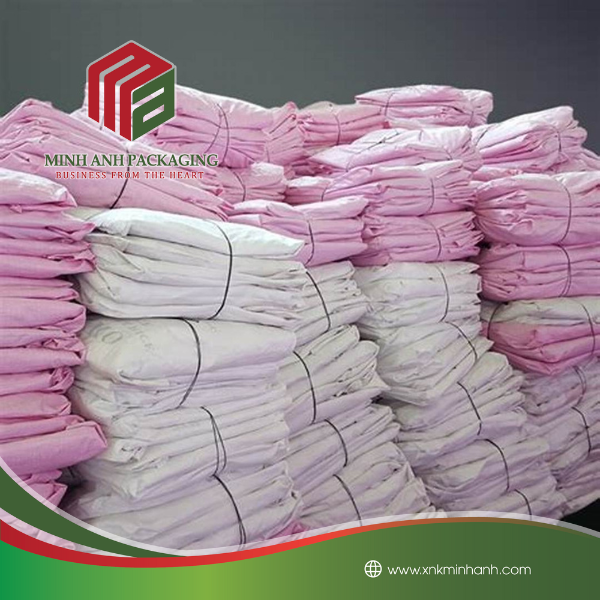
FIBC Bags, also known as jumbo bags, are flexible intermediate bulk containers made from polypropylene, designed for storing and transporting dry, bulk goods like grains, chemicals, and construction materials. They offer numerous advantages including large capacity, cost savings, environmental protection, and safety for products.
FIBC Bag, also known as jumbo bag or bulk bag, is a type of packaging made from woven polypropylene fabric, designed to contain and transport dry and bulk goods such as grains, plastic beads, chemicals and materials. construction materials. The name FIBC stands for “Flexible Intermediate Bulk Container,” meaning flexible intermediate container.
Born in the 1940s, FIBC Bag has become an important part of the packaging industry. With the ability to hold from a few hundred kilograms to several tons, FIBC Bag meets the needs of transporting and storing goods effectively and safely. The versatility and durability of this type of packaging has made it the top choice in many industries, from agriculture and chemicals to construction and pharmaceuticals.
Types of FIBC Bags and applications
FIBC Bags come in many different types, each designed to meet the specific requirements of each type of goods. Below are common types of FIBC Bags and their applications.
Standard FIBC
Standard FIBC is the most common type, suitable for storing common dry goods such as grain, sand, flour and plastic granules.
- Capacity: 500 kg to 2000 kg, depending on the size and thickness of the bag.
- Application in agriculture: Contains grains and seeds.
- Application in construction industry: Contains sand and gravel.
- Applications in the plastic industry: Contains plastic granules.
Anti-static FIBC
Anti-static FIBC is specially designed to prevent static electricity, ensuring safety when storing and transporting flammable and explosive goods.
- Application in chemical industry: Contains chemical powder.
- Application in plastic industry: Contains flammable plastic granules.
- Applications in other industries: Contains flammable products.
Heat-resistant FIBC
Heat-resistant FIBCs are resistant to high temperatures, making them ideal for storing and transporting goods under variable temperature conditions.
- Application in chemical industry: Contains high temperature chemicals.
- Application in pharmaceutical industry: Contains medicinal herbs that need to be preserved at high temperatures.
- Applications in the food industry: Contains heat-resistant products.
FIBC has an inner lining
FIBC has an inner lining used to contain goods that require high cleanliness, helping to protect products from moisture and dust.
- Application in food industry: Contains dry food, food powder.
- Application in pharmaceutical industry: Contains pharmaceutical ingredients.
- Applications in the chemical industry: Contains chemicals that require special protection.
FIBC isolation
Isolation FIBCs are designed to contain hazardous materials, prevent leaks and protect workers and the environment.
- Application in chemical industry: Contains hazardous waste.
- Applications in the pharmaceutical industry: Contains sensitive materials.
- Applications in other industries: Contains toxic materials.
Advantages of using FIBC Bag
Using FIBC Bag brings many outstanding advantages, helping to optimize the process of transporting and storing goods. Here are the main advantages:
Large capacity
- Storage capacity: They can hold from 500 kg to 2000 kg, helping to save space compared to small packaging types.
- Optimize storage space: Stacking ability helps save warehouse space.
Cost savings
- Shopping costs: They can be reused many times, minimizing the cost of purchasing new packaging.
- Transportation costs: Large storage capacity helps reduce the number of transportation times, thereby saving transportation costs.
Environmental protection
- Recycled materials: FIBC Bag is made from polypropylene, a recyclable plastic, minimizing negative impacts on the environment.
- Reduce waste: Reusing FIBC bags many times helps reduce plastic waste.
Easy to transport and store
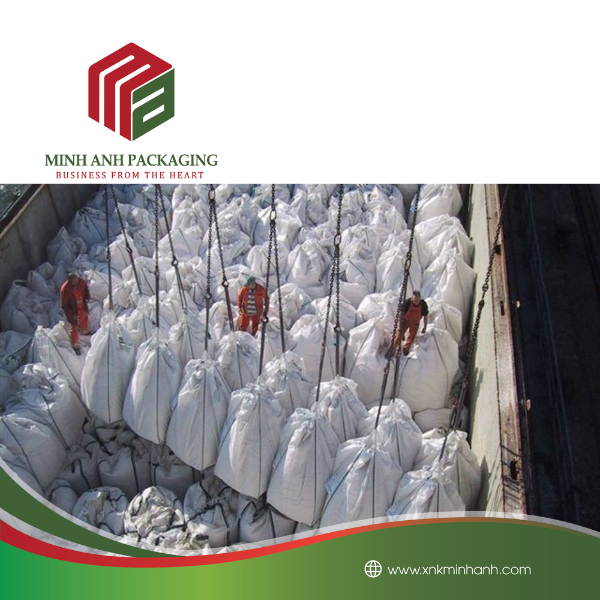
- Flexible design: They have an easy-to-stack design, helping to optimize space on vehicles such as trucks, containers, and ships.
- Convenience in handling: Bags are often equipped with lifting straps, making them easy to lift with machinery such as a forklift.
Ensure product safety
- Protection from external factors: FIBC types are anti-static, heat-resistant and have a lining that helps protect the product from moisture, temperature and static electricity.
- Reduced risk of damage: Rugged design and durable materials help minimize the risk of damage to goods during transportation and storage.
Diversity of applications
- Use in many industries: It is suitable for many industries such as agriculture, chemicals, food, pharmaceuticals and construction.
- Customized according to needs: Can be manufactured according to specific requirements in terms of size, load capacity and protection features.
Production process and quality control of FIBC Bag
FIBC Bag production and quality testing processes are strictly implemented to ensure the final product meets international standards. Below are the main steps in the FIBC Bag production and quality inspection process.
Raw materials and production process
- Choosing raw materials: High quality polypropylene was chosen as the main material due to its durability, flexibility and load-bearing capacity.
- Weaving: Polypropylene is woven into fabric according to predetermined specifications to ensure strength and durability.
- Cutting and sewing: After weaving, polypropylene fabric will be cut to the required size and sewn into bags with sturdy seams to ensure durability and load-bearing capacity.
- Assembly and finishing: FIBC Bag parts such as lifting straps and inner lining will be assembled and thoroughly inspected before the product is completed.
Check quality and standards to be met
- Durability test: FIBC Bag is tested for mechanical durability to ensure load-bearing capacity according to required standards.
- Anti-static and heat-resistant testing: For anti-static and heat-resistant FIBCs, specialized tests are conducted to ensure the product meets safety requirements.
- Tested for product protection: FIBCs have an inner lining that is tested for its ability to protect the product from moisture, dust, and other external factors.
International certification and standards
- ISO certification: FIBC Bag often achieves ISO certification for quality management, ensuring products meet international standards.
- EFIBCA Standard: The European Federation for FIBC Packaging (EFIBCA) provides strict safety and quality standards that FIBC manufacturers need to comply with.
Quality inspection process
- Input inspection: Input materials are thoroughly inspected before being put into production.
- Inspection during production: Each step in the production process has quality checks to ensure there are no manufacturing errors.
- Finished product inspection: The finished product undergoes final inspection before leaving the factory, including testing for load, durability and special features.

Hãy là người đầu tiên nhận xét “FIBC Bags: Packaging Solutions for Dry and Bulk Goods”
Sản phẩm tương tự


Tin Tức Bao Bì
Food Cling Film: Outstanding Advantages in Food Preservation

Tin Tức Bao Bì

Tin Tức Bao Bì

Tin Tức Bao Bì

Tin Tức Bao Bì

Tin Tức Bao Bì

Tin Tức Bao Bì


Đánh giá
Chưa có đánh giá nào.